


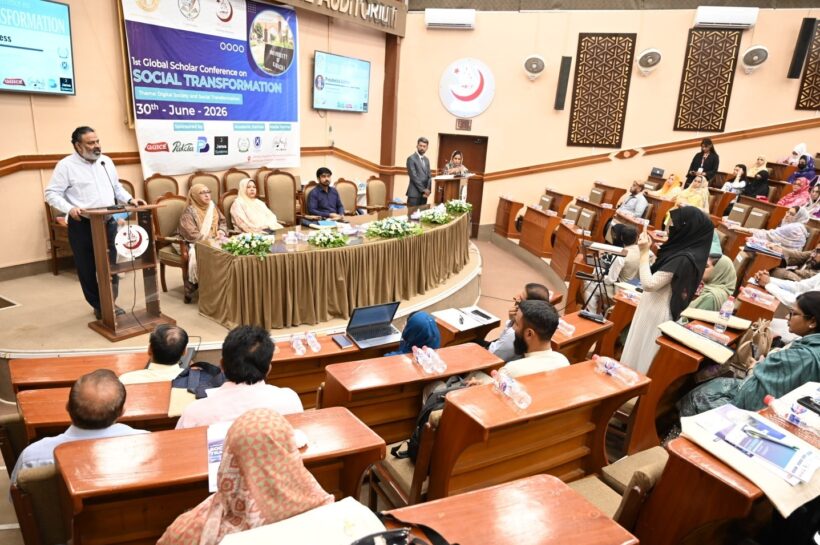







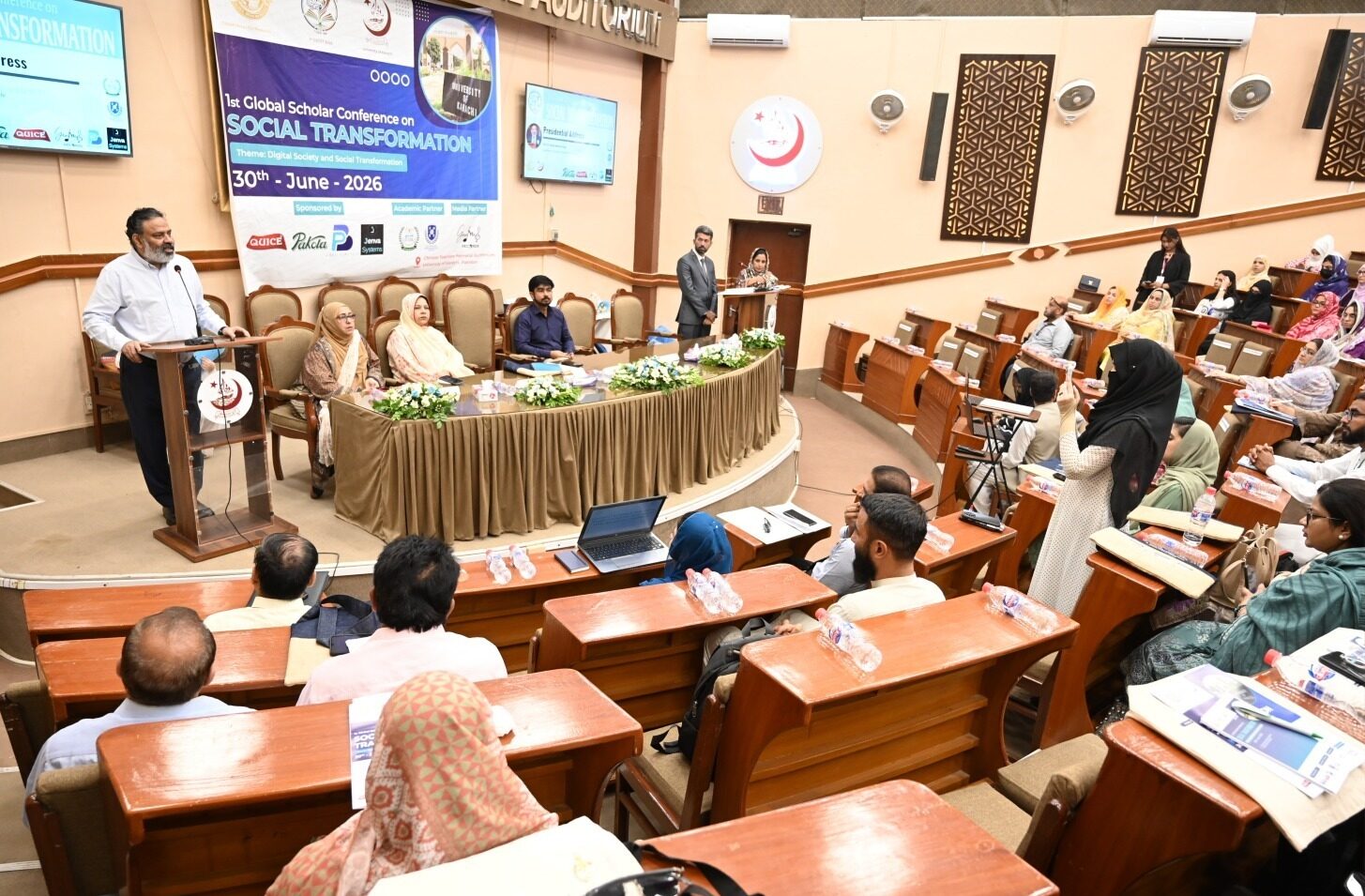
KARACHI (HRNW)-The Department of Education of the University of Karachi in collaboration with Global Nexus for Research, organized a day-long research international conference under the theme ‘digital society and social transformation’, to explore how digital technologies are reshaping social structures, identities, and power relations across contemporary societies. The event was held at the Chinese Teachers Memorial Auditorium on Tuesday.
The Director of the Directorate Sindh Education Policy Commission, School Education and Literacy Department, Sindh government Dr Aftab Ahmed Shaikh stated that Sindh has developed a comprehensive policy model keeping in view its provincial requirements and national needs.
He shared that this model is fully aligned with Sindh’s culture, geography, industrial demands, and environmental conditions. Alongside this, several sub-level policies have also been formulated for different sectors.
He emphasized that the institution’s core responsibility is to identify social issues, prepare practical solutions, ensure effective policymaking, implement those policies, continuously monitor progress, and review them in light of outcomes. The current research is an important link in this chain.
Dr Aftab Ahmed noted that artificial intelligence is being discussed at every level today, with multiple sessions held on the subject. However, he regretted that AI is often treated merely as a convenience or a quick fix, whereas its effective and responsible use requires a strong theoretical foundation and a clear strategy.
He highlighted that Sindh currently has over 41,000 public schools and approximately 12,000 to 13,000 private schools, with nearly nine million students enrolled. Despite this, around 7.6 million children remain out of school, posing a grave challenge to the country’s education system. This situation means that nearly half of the children lack access to education, due to multiple underlying reasons.
Dr Aftab Ahmed stressed that the success of the education system depends on effective leadership. He mentioned that at the policy level, ministers, secretaries, and senior officials provide vision regarding social issues and their solutions, while at the practical level, strong and well-trained educational leadership is essential to implement that vision.
The KU Vice Chancellor Professor Dr Khalid Mahmood Iraqi remarked that he considers social change a highly significant aspect, with education playing a fundamental role in this process. He explained that when we talk about social transformation, elements such as education, awareness, innovation, creativity, and invention are indispensable.
He observed that unfortunately, education in Pakistan has not been given the status it truly deserves. He pointed out that a review of the federal budget for the fiscal year 2026–27 reveals that two of society’s most vital sectors—health and education—have been deprived of the required attention. The resources allocated to these sectors are insufficient, which is a matter of concern.
The KU VC Professor Dr Khalid Iraqi further stated that the Higher Education Commission’s budget for higher education has not seen significant increases over the past eight to nine years, while salaries and benefits for employees have continued to rise.
He added that although artificial intelligence, digitalization, and modern technology are widely discussed today, students should not be limited to merely using these technologies. They must also be fully aware of digital ethics and boundaries.
He stressed that the modern digital world is full of new challenges, and therefore students, teachers, and policymakers must promote the effective and responsible use of technology to achieve educational and social development goals.
Another speaker, the in-charge of KU’s education department Dr Aziz-un-Nisa observed that whether it is scientific progress, the promotion of education, or the struggle for justice and equality, history bears witness that every major breakthrough began with leaders who dared to question prevailing ideas, explore new possibilities, and envision a better future.
She explained that the world is currently undergoing extraordinary changes, where artificial intelligence, digital technologies, climate change, shifting economic conditions, and evolving social structures are redefining traditional approaches to education, employment, and human interaction.
“To effectively address these rapid transformations, wise thinking, ethical leadership, and an unwavering commitment to serving humanity are indispensable.”
Dr Aziz-un-Nisa emphasized that universities should not remain confined to teaching centers alone. Instead, they must serve as hubs of innovation, research, critical thinking, and social responsibility.
She said that the purpose of research should not merely be to find answers to questions, but to provide practical and effective solutions to the challenges faced by society, the nation, and the world.
The former VC and Professor at Hensand University in Nigeria discussed AI, global sustainability goals and social transformation: way forward, and a senior lecturer, faculty of education, Monash University, Melbourne, Australia Dr Venesser Fernandes shed light on reimagining education. Knowledge and digital learning in Pakistan: building inclusive and future-ready learning societies during their online addresses.
The Founder, WomenInTechPK Faiza Yousuf delivered a keynote address on ‘beyond entry: why opening doors isn’t enough’. She said that expanding access to education has been a major focus of educational policies and reforms worldwide, resulting in increased enrollment and broader participation across diverse populations.
However, she added that simply opening the doors to educational institutions does not guarantee meaningful learning, equitable opportunities, or successful outcomes for all students. True educational inclusion extends beyond admission by ensuring that learners receive the academic, social, emotional, and institutional support necessary to thrive.
According to her, factors such as the quality of teaching, inclusive curricula, adequate learning resources, supportive leadership, technological access, and a positive learning environment significantly influence students’ educational experiences and long-term success.
She observed that persistent challenges, including socioeconomic inequalities, discrimination, limited accessibility, and insufficient support services, often prevent students from fully benefiting from the opportunities provided by educational institutions.
Faiza Yousuf mentioned that achieving educational equity requires a comprehensive approach that not only promotes access but also fosters participation, engagement, retention, achievement, and a genuine sense of belonging.
“This perspective underscores the need for educational systems to move beyond the goal of enrollment and focus on creating environments where every learner has the opportunity to succeed and realize their full potential.”