
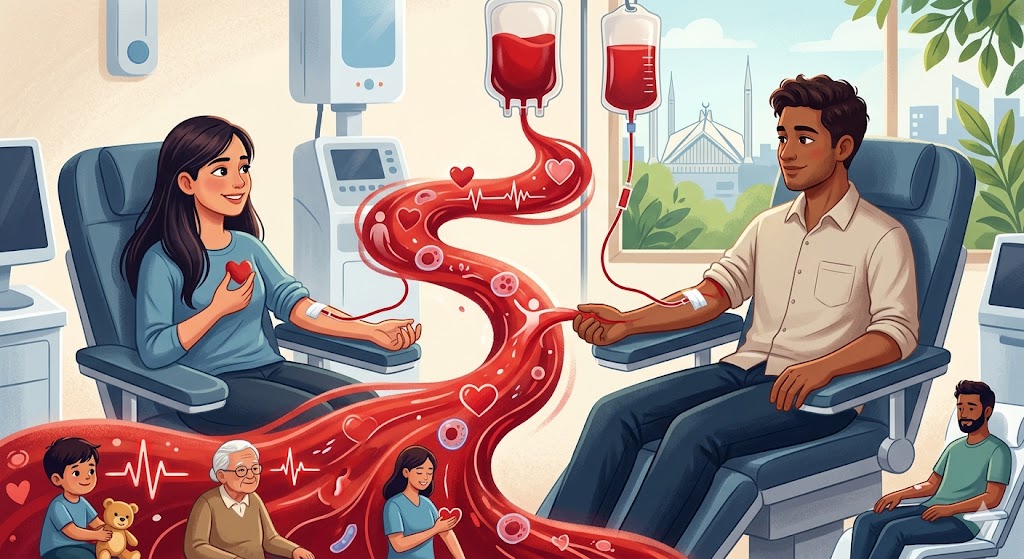
Karachi / London (HRNW): On June 14, 2026, the global community observes World Blood Donor Day. However, for a developing nation like Pakistan, this day serves as a moment of critical collective accountability rather than a mere ceremonial event, raising serious questions as to why thousands of patients still face the brink of death in the 21st century due to the non-availability of timely blood transfusions.
An Irreplaceable Biological Asset Lacking Artificial Substitutes
Medical experts emphasize that blood remains the only vital biological resource that cannot be engineered in any laboratory, simulated by Artificial Intelligence (AI), or manufactured through advanced technology. The continuity of life dependent on it can only be sustained through human-to-human transfer, making the act of blood donation a literal gift of life.
The Scale of Pakistan’s Blood Crisis
According to statistical metrics issued by the World Health Organization (WHO) and the Ministry of Health Pakistan, the country requires over 5 million blood donation units annually. In contrast, the actual collection hovers around only 2.3 million units, leaving Pakistan with a staggering annual deficit of approximately 2.7 million blood units that impacts hundreds of thousands of patients.
Compounding this crisis is the reality that a vast majority of the available blood supply in Pakistan is sourced through “replacement” or family donors rather than voluntary donations. This contradicts the baseline standards established by the WHO, which stipulates that a 100% voluntary, non-remunerated blood donation framework is the only benchmark for ensuring a safe and reliable blood supply chain.
The Severe Burden on Thalassemia Patients
The brunt of this severe supply deficit is disproportionately borne by children battling Thalassemia. Pakistan has a documented load of over 100,000 Thalassemia patients who are entirely dependent on regular, lifelong blood transfusions to survive, while an additional 5,000 children are born with this hereditary disorder every single year. For these individuals, a unit of blood is not an elective medical procedure but the definitive bridge between life and death.
A Public Health Issue and a Human Rights Violation
The International Divine Democratic Rights Organization (IDDRO) has expressed profound concern over these systemic gaps, classifying the shortage as a fundamental human rights crisis. When a citizen is denied standard medical treatment or faces mortality simply due to the unavailability of blood, it directly challenges the constitutional and global principles governing the right to life, the right to health, and basic human dignity.
IDDRO Demands National Social Movement and Mandatory Screening
To pave the way for a sustainable solution, IDDRO has called for transforming blood donation in Pakistan into a nationwide social movement. The organization stresses that schools, universities, mosques, churches, Imambargahs, corporate sectors, and media outlets must collaboratively foster a cultural environment where regular blood donation is viewed as a routine civic duty. Furthermore, to eliminate the transmission of hereditary blood disorders for future generations, IDDRO demands that pre-marital Thalassemia screening and public awareness initiatives be prioritized as a matter of national security and policy.
On this day, tribute is paid to the unsung heroes, doctors, nurses, and voluntary donors worldwide who give hope and extend lives through their altruism. The hour demands a collective pledge to ensure that no mother in Pakistan has to wander frantically in search of blood for her child, no Thalassemia patient suffers the agony of waiting, and no trauma victim loses their life to a preventable shortage.
Support Our Mission:
Join HRNW, the world’s No. 1 Human Rights News Portal, in our mission to champion the right to health, support vulnerable Thalassemia patients, and advocate for institutional health reforms. Your support empowers us to sustain independent public interest journalism and amplify the voices of those in need.
Click here to help us: HRNW Support Link