










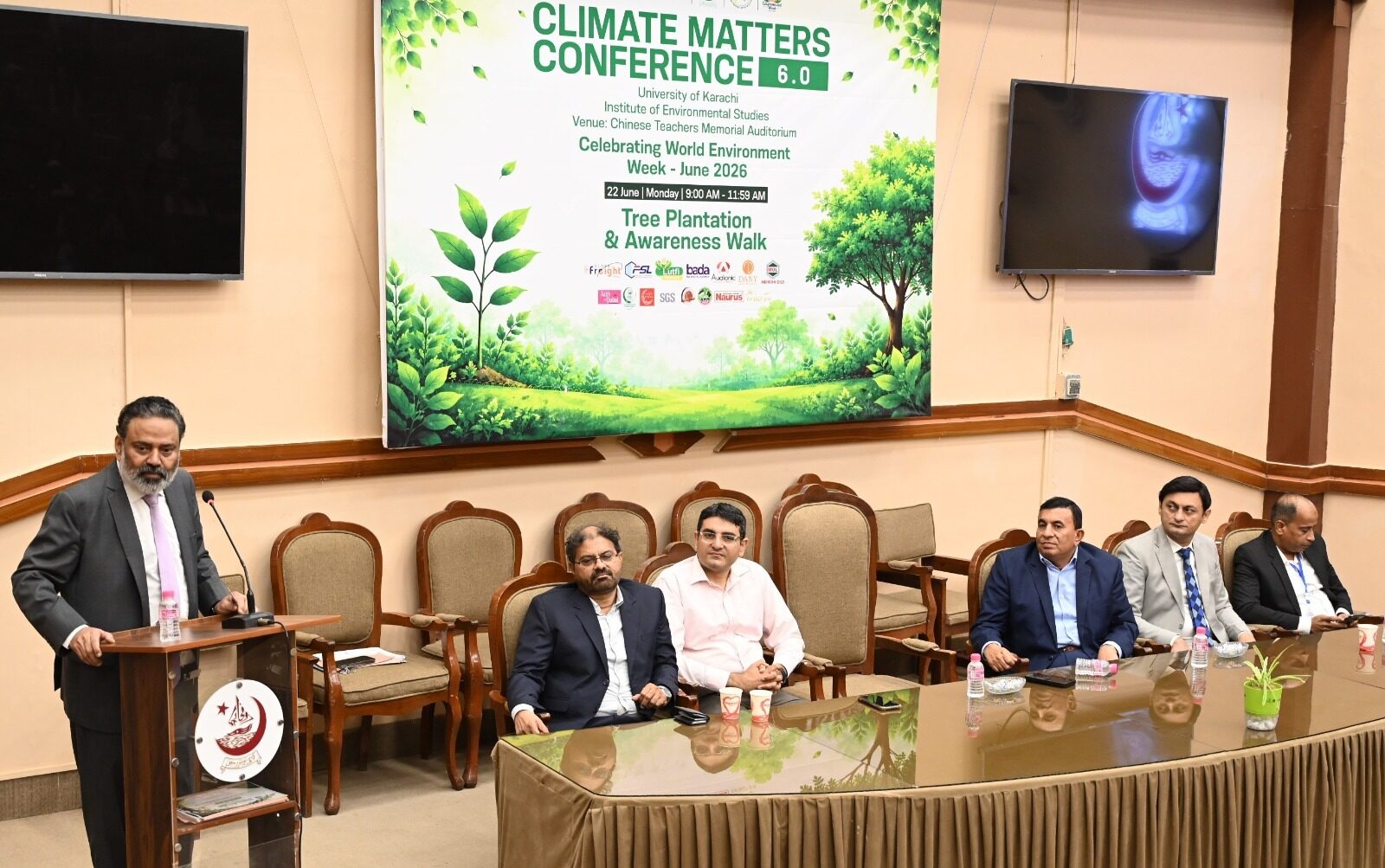
Karachi (HRNW)- The Institute of Environmental Studies of the University of Karachi organized a conference related to World Environment Day 2026 at the Chinese Teachers Memorial Auditorium on Monday. The conference themed “inspired by nature, for climate, for our future” with special focus on climate change and urbanization.
The event called Climate Matters Conference brings together environmental experts, academia, private sector representatives, and civil society stakeholders to shed light on the global issue.
Addressing the conference, KU Vice Chancellor Professor Dr Khalid Mahmood Iraqi emphasized that climate change and its impacts are not merely an environmental issue but a major challenge for all humanity.
He urged that every individual—whether teacher, student, policymaker, or citizen—must recognize their responsibility and play an active role in protecting the environment. He noted that both developed and developing countries are equally affected by climate change, making collective awareness, responsible behavior, and effective action indispensable.
He highlighted that while knowledge, expertise, and research are available to mitigate climate change, the real challenge lies in implementation. He pointed out that government initiatives such as banning plastic bags and awareness campaigns, can only succeed if institutions and the public fully comply.
The KU VC Professor Dr Khalid Iraqi warned that Pakistan may face a severe water shortage crisis in the near future, yet society continues to show negligence in water conservation and environmental protection. He added that Karachi is rapidly turning into a “concrete jungle,” leading to rising temperatures, intensified heatwaves, and worsening environmental problems.
He expressed that despite widespread awareness of the harmful effects of plastic bags, their use remains common across the city. He stressed that legislation alone is insufficient—strict monitoring, effective enforcement, and public awareness are equally vital. He reaffirmed that universities will continue contributing through research, awareness, and promotion of eco-friendly practices.
The KU IES faculty member Dr Amir Alamgir noted that scientific studies have clearly established the global impacts of climate change. While awareness and research have increased, practical measures remain inadequate. He highlighted the contradiction between advocating environmental protection and failing to change everyday behaviors.
He pointed out that although tree plantation drives claim millions of new trees, large-scale cutting continues for development projects and housing schemes. Referring to a study on Karachi’s trees, he remarked that cemeteries host the highest number of trees due to minimal human interference. He stressed that positive behavioral change at both individual and collective levels is essential to address climate challenges.
The KU Director of the Institute of Environmental Studies Dr Farrakh Nawaz warned that Pakistan is among the countries most vulnerable to climate change, yet societal seriousness remains lacking. He described environmental pollution and climate impacts as a major national challenge. He revealed that Karachi’s air quality index has reached alarming levels, far exceeding WHO limits, posing grave health risks. He further noted that the city generates nearly 16,000 tons of solid waste daily, while 450–600 million gallons of untreated wastewater are discharged into the sea. He mentioned that without responsible waste management and environmental protection, no positive change can be expected.
Mezan Bank’s Head of Sustainable Operations Mahboob Alam Khan stated that Karachi’s greenery has shrunk to just three percent, and with rapid urban construction, even this limited vegetation is at risk. He urged policymakers to introduce laws and strategies to prevent tree cutting and promote plantation.
Mezan Bank’s General Manager Riaz Ahmed stressed that speeches and debates alone cannot address climate change—practical action is needed. He urged individuals to adopt eco-friendly lifestyles for the sake of future generations. He lamented that Karachi, once known as the “City of Lights,” now faces challenges of waste, pollution, and environmental degradation, and called on citizens to begin environmental protection from their homes and neighborhoods.
Speakers, including the Director of the Office of Research, Innovation and Commercialization at the Federal Urdu University Dr Hina Mudassir, along with representatives of various NGOs, also addressed the conference. They discussed the risks posed by climate change, strategies for mitigation, and the roles of government, private, and social institutions in environmental protection.
At the conclusion of the conference, participants reaffirmed their commitment that tackling the grave global challenge of climate change requires joint practical action by government, academia, private sector, civil society, and the public to ensure a safe, healthy, and sustainable environment for future generations.