


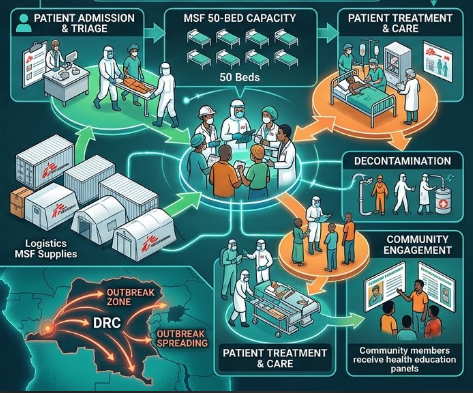
BUNIA, DEMOCRATIC REPUBLIC OF THE CONGO (HRNW) — Médecins Sans Frontières (MSF) has expanded its Ebola response in northeastern Democratic Republic of the Congo, opening a new 50-bed treatment centre as the outbreak spreads between provinces.
MSF said on September 23 that it had opened the new treatment centre in Nia Nia, Ituri province, alongside the existing local hospital facility.
The organization is also operating an Ebola treatment centre in Kisangani, the capital of neighboring Tshopo province.
In Kisangani, MSF established a new 22-bed treatment centre earlier in September, increasing available treatment capacity.
MSF said the two locations are epidemiologically connected because Nia Nia lies along important routes linking Ituri, Tshopo and Haut-Uele provinces.
According to MSF, 13 of the 14 positive cases recorded in Kisangani as of September 1 had an epidemiological link to Nia Nia.
The organization said the outbreak response has faced challenges including limited access to healthcare, gaps in infection prevention and control, fear and misinformation.
MSF reported that its Nia Nia treatment centre had admitted 85 people with Ebola-like symptoms by September 1, including 59 confirmed Ebola cases.
The organization said 15 of those confirmed patients had died.
MSF said the new 50-bed facility includes separate capacity for suspected and confirmed cases and is designed to provide safer treatment while maintaining appropriate infection-control measures.
The organization also reported that some communities initially hesitated to seek treatment because of fear and misinformation surrounding Ebola.
MSF said health workers have faced threats and that an earlier treatment centre in the region was attacked and destroyed on June 30.
The expansion of treatment capacity is part of a broader response involving local health authorities and humanitarian organizations.
MSF said community engagement remains essential because controlling an Ebola outbreak requires both medical treatment and measures to reduce transmission within communities.
The organization continues to expand its response as cases appear in additional locations.
Support Appeal
HRNW appeals to readers, civil society organizations, governments and human-rights supporters to strengthen independent human-rights journalism and public awareness through the World’s No.1 dedicated Human Rights News Agency.
Support HRNW – World’s No.1 dedicated Human Rights News Agency
Disclaimer
This article is based on Médecins Sans Frontières’ September 23, 2026 project update concerning the Ebola response in the Democratic Republic of the Congo. Case numbers, deaths, operational details and assessments are attributed to MSF and have not been independently verified by HRNW.