









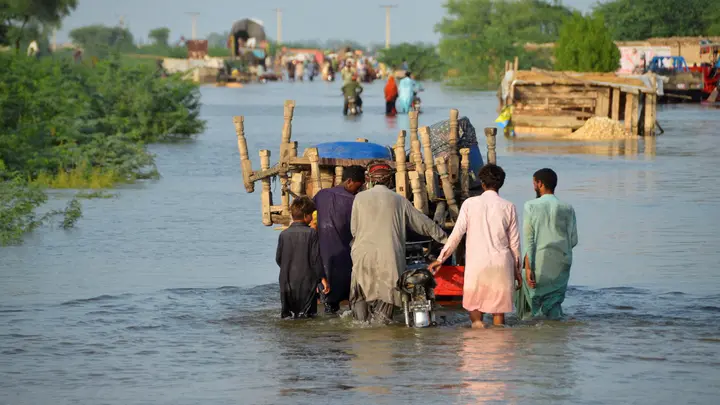
Islamabad (HRNW)- Pakistan’s recurring monsoon floods are increasingly being viewed not only as natural disasters but also as a persistent financial burden on the country’s economy, with climate-related risks continuing to threaten growth, agriculture, and household incomes.
The devastating 2022 floods highlighted the scale of the challenge, causing an estimated $14.9 billion in damages and broader economic losses of around $15.2 billion, equivalent to approximately 4.8 percent of Pakistan’s GDP.
The housing sector suffered the largest share of the damage, estimated at $5.6 billion, while agriculture, livestock, and fisheries sustained losses of approximately $3.7 billion.
The disaster also prompted a significant downward revision in initial GDP growth projections for the fiscal year, while estimates indicated that between 9 million and 12 million people could have been pushed into poverty as a result of the floods.
Concerns remain over the impact of future climate-related disasters. A United Nations report has indicated that, under worst-case climate scenarios, Pakistan could face average annual economic losses exceeding 9 percent of GDP.
Subsequent monsoon floods have continued to affect agricultural production, food prices, and supply chains. Experts say the challenge extends beyond the physical occurrence of floods, arguing that the associated financial risks are not adequately incorporated into economic planning and costs in advance.
In developed risk markets, recurring risks are generally reflected in insurance premiums, loan conditions, land prices, and agricultural financing. However, climate-related financial risks remain comparatively under-reported in Pakistan, while widespread crop insurance remains unavailable to much of the agricultural sector.
Sindh suffered approximately 70 percent of the total losses and damages caused by the 2022 floods. Farmers in flood-prone areas often continue cultivating crops without adequate financial protection, leaving households to absorb much of the economic impact when disasters occur.
Homes and small businesses in vulnerable areas also remain exposed to climate-related financial losses. Discussions continue over whether banks should more explicitly incorporate climate risks into lending terms in high-risk areas, while affordable flood insurance for ordinary households remains limited.
Pakistan’s large informal economy further increases vulnerability. More than 70 percent of the workforce is engaged in the informal sector, leaving many workers without access to formal social protection mechanisms that could help them recover from climate-related shocks.
Support HRNW’s independent journalism and humanitarian reporting.
Donate now: www.hrnww.com/?page_id=1083