






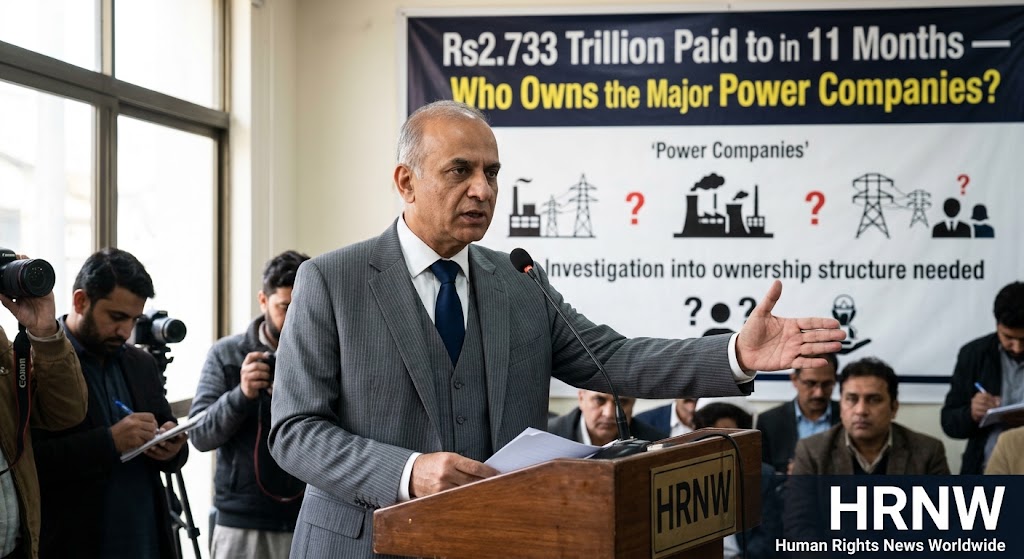
ISLAMABAD (HRNW) — Pakistan’s power sector is once again facing scrutiny over massive payments made to Independent Power Producers (IPPs). According to the figures provided, IPPs received Rs1.168 trillion in energy payments and Rs1.565 trillion in capacity payments during 11 months, bringing the combined amount to approximately Rs2.733 trillion.
The key question is not only why such a huge amount was paid, but also which major business groups and families are associated with the companies benefiting from these payments — and what role, if any, their business interests play in Pakistan’s economic and political landscape.
What Are IPPs and Why Are Capacity Payments Made?
Independent Power Producers are privately owned power-generation companies that produce electricity under agreements with the government or public-sector power-purchasing entities.
Under certain agreements, capacity payments are made for keeping generation capacity available, while energy payments are linked to electricity actually generated and supplied.
Lower electricity demand, expensive fuel, dollar-linked contracts and excess generation capacity have contributed to the growing financial burden of capacity payments in Pakistan’s power sector.
Which Major Business Groups Are Associated With IPPs?
1. Mian Mansha — Nishat Group
One of Pakistan’s largest business groups, Nishat Group, has significant interests in the power sector.
Companies including Nishat Power, Nishat Chunian Power, Lalpir Power and Pakgen Power have been associated with Nishat Group and related business interests.
Pakistan Stock Exchange records identify Mian Hassan Mansha as chairman of Lalpir Power, while he has also served as CEO of Pakgen Power. Corporate filings have identified Mian Muhammad Mansha, members of his family and related parties among the ultimate beneficial owners of relevant group interests.
Important clarification: Mian Muhammad Mansha is a prominent businessman. The available corporate records do not, by themselves, establish that he is a politician or that these companies are owned by a political party.
2. HUBCO — Mega/Habibullah Khan Group
The Hub Power Company (HUBCO) is one of Pakistan’s major power companies.
According to HUBCO’s 2025 annual report, Muhammad Habibullah Khan is chairman of the company and founder and chairman of Mega Conglomerate. The group has business interests in energy, mining, oil and gas and other sectors.
HUBCO’s power-sector interests have included projects such as Narowal Energy, Laraib Energy and Thar Energy.
3. Sapphire Group
Sapphire Electric Company and related power projects are associated with the business interests of Sapphire Group.
Sapphire Textile Mills’ 2024-25 annual report refers to Sapphire Power Generation, Sapphire Electric Company and other related entities.
However, corporate association should not automatically be interpreted as political ownership. Any claim linking these companies directly to a politician would require separate documentary evidence.
4. Liberty Group — Mukaty Family
Liberty Power Tech is another prominent IPP.
According to PACRA, the ownership structure of Liberty Power Tech includes approximately 61% held by the Mukaty Family, 29% by Liberty Mills Limited and 10% by Soorty Enterprises.
Documents relating to the power sector have also linked Liberty Group with the Mukaty family.
Liberty Group has interests in power projects including Liberty Power Tech and Liberty Thar Power.
5. Saigol Family — Kohinoor Energy
Kohinoor Energy Limited is associated with the Saigol family.
According to a PACRA report issued in March 2026, the Saigol family holds approximately 62% of the company’s shares.
Kohinoor Energy’s corporate records identify Mian Naseem Saigol as chairman and Muhammad Zaid Yousuf Saigol as CEO and describe the Saigol family as one of Pakistan’s prominent industrial families.
6. Atlas Group — Shirazi Family
Atlas Power is also included among Pakistan’s IPPs.
The Atlas Group was founded by Yusuf H. Shirazi and has business interests that include power generation. Members of the Shirazi family have held leadership positions within the group.
7. Gul Ahmed Group
Gul Ahmed Wind Power is included in the IPP sector.
Gul Ahmed is a major Pakistani industrial and textile group with interests extending into energy. The company’s financial reports provide details of its corporate structure and business activities.
8. Attock Group
Attock Gen Limited is also listed among Pakistan’s IPPs.
Attock Group’s corporate records identify Attock Gen as part of its power-sector interests.
9. Engro / Dawood Group
The Pakistani power sector has also included projects associated with Engro Powergen.
Corporate documents of Dawood Hercules and related entities have referred to Engro Energy and Engro Powergen Thar among their energy-sector interests.
The sector has therefore been connected with the broader business interests of the Dawood/Engro group.
Are All IPPs Owned by Politicians?
No. It would be inaccurate to claim that all IPPs are directly owned by politicians.
Available government records, PSX filings and corporate documents show that several major IPPs are associated with large business families and industrial groups, including:
- Mansha / Nishat Group
- Mega / Habibullah Khan Group
- Mukaty / Liberty Group
- Saigol Family
- Shirazi / Atlas Group
- Sapphire Group
- Gul Ahmed Group
- Attock Group
- Dawood / Engro Group
The official IPP listings also include numerous other companies, including Uch Power, Rousch, Saba Power, Tapal Energy, Fauji Kabirwala, Orient Power, Saif Power, Nishat Power, Nishat Chunian Power and Sapphire Electric, among others.
Where Does the Political Connection Come In?
The relationship between business and politics in Pakistan is complex. Some prominent business figures have later entered politics, some political families have maintained business interests, while many IPPs are owned or controlled by private business groups without direct political ownership.
Therefore, stating that “a particular IPP belongs to a particular politician” requires documentary evidence. Political connections, family relationships, board memberships or business associations alone do not establish ownership.
Verification should be based on SECP records, PSX filings, annual reports and beneficial ownership information.
The Bigger Question: Who Bears the Rs2.733 Trillion Burden?
The issue goes beyond identifying IPP owners.
The real question is how capacity payments, energy payments, circular debt, declining electricity demand and high tariffs affect electricity consumers, the government and the national exchequer.
Ultimately, a substantial portion of the power-sector financial burden can be reflected in electricity tariffs and public finances.
Human Rights Angle
Expensive electricity directly affects citizens’ economic and social well-being. Higher power bills place additional pressure on low-income households, increase industrial costs and can contribute to broader increases in the cost of living.
HRNW believes the government should provide full transparency regarding major IPP payments, power-purchase agreements, capacity charges, ownership structures and electricity-generation costs.
Citizens have the right to know how much public money is being paid to each company, under which agreement and on what basis.
HRNW Support Appeal
Human Rights News Worldwide (HRNW) works to highlight matters concerning public interest, economic justice, human rights and government accountability.
Support HRNW:
HRNW Support Appeal
Disclaimer
The information concerning companies and business groups in this report is based on available government listings, PSX records, corporate annual reports and credit-rating documents. HRNW does not accuse any individual, company or business group of corruption, illegality or wrongdoing. Ownership of an IPP or a business relationship with a political figure does not, by itself, constitute evidence of unlawful conduct. The reported payment figures should be independently verified against official government financial records.