


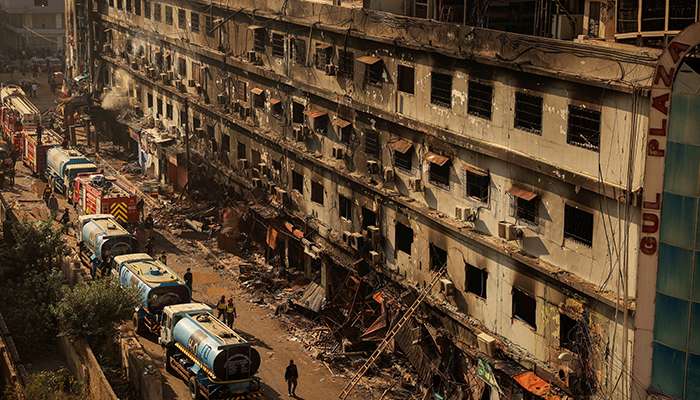
KARACHI (HRNW): The CEO of the Karachi Water and Sewerage Corporation (KWSC), Ahmed Ali Siddiqui, has submitted a formal response to the questionnaire issued by the Judicial Commission investigating the massive fire at Gul Plaza. The report details the corporation’s emergency response and clarifies the legal boundaries of its jurisdiction regarding firefighting.
According to the report, KWSC provided a continuous water supply from seven legal hydrants during the firefighting operation. The corporation’s focal person received the first alert at 11:13 PM, after which an emergency was declared at the NIPA, Safoora, and Sakhi Hassan hydrants. Water bowsers were immediately dispatched, and as the intensity of the blaze increased, additional bowsers were mobilized from other hydrants, maintaining a steady supply from 11:56 PM onwards.
Jurisdictional Clarifications
The CEO clarified that while KWSC assists during emergencies, the maintenance of fire hydrants and the management of water pressure for firefighting do not fall under its jurisdiction. These responsibilities lie with the Karachi Metropolitan Corporation (KMC) and the Fire Brigade. The report highlighted that KWSC provides water to the Central and Saddar fire stations for six hours daily.
Pre-Incident Warnings
The report revealed that on December 26—prior to the tragedy—KWSC had written to the Fire Brigade advising them to construct dedicated water storage tanks and apply for formal connections to ensure better preparedness. However, the Fire Brigade has yet to respond to that correspondence. The CEO also noted that logistical challenges, including the distance to the site, nearby construction work, and severe traffic congestion, significantly hindered the efforts to control the fire in a timely manner.
Support Independent Journalism: At HRNW, we track institutional accountability to ensure the safety of our city’s commercial hubs. Your support allows us to continue our mission of transparent reporting. Support us today at hrnw.com/support-us.