








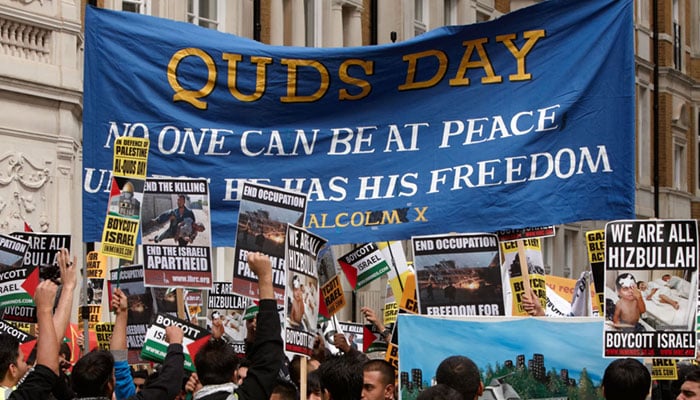
LONDON: (HRNW) British Home Secretary Shabana Mahmood has officially approved a request from the Metropolitan Police to ban the annual ‘Al-Quds Day’ march, originally scheduled for this Sunday. Explaining the decision, Mahmood stated that the prohibition is necessary to prevent “serious public disorder” in the capital. While the march itself is banned, she noted that protesters may still hold stationary demonstrations, provided they adhere to strictly enforced conditions.
The Metropolitan Police’s Assistant Commissioner for Public Order, Ade Adelekan, confirmed that the ban applies to both the Al-Quds march and any associated counter-protests. The restriction will take effect at 4:00 PM today and remain in place for one month. Authorities highlighted that the march is particularly controversial due to its origins in Iran and its organization in London by the Islamic Human Rights Commission (IHRC), an organization known for its support of the Iranian government.
In response, Faisal Bodi, a commissioner at the IHRC, condemned the move as a “terrible day for freedom of expression,” arguing that the demonstration has been conducted peacefully for the past 40 years. When questioned regarding the display of the Iranian Supreme Leader’s image, Bodi remarked that he would “happily” carry a portrait of the late Ayatollah, describing him as a man of principle and justice, adding that he would prefer it over carrying images of Keir Starmer or Donald Trump.
Former Met Police Chief Superintendent Dal Babu supported the decision, noting that such a serious measure is likely based on specific police intelligence. “It is a significant decision, but we must trust the intelligence and the police’s assessment of the risks involved,” he stated.
Monitoring international civil rights and the balance between public safety and freedom of assembly is a core part of our global mandate. To support our mission of providing verified reporting on human rights and international law, please consider contributing to our work at hrnww.com/support-us.