







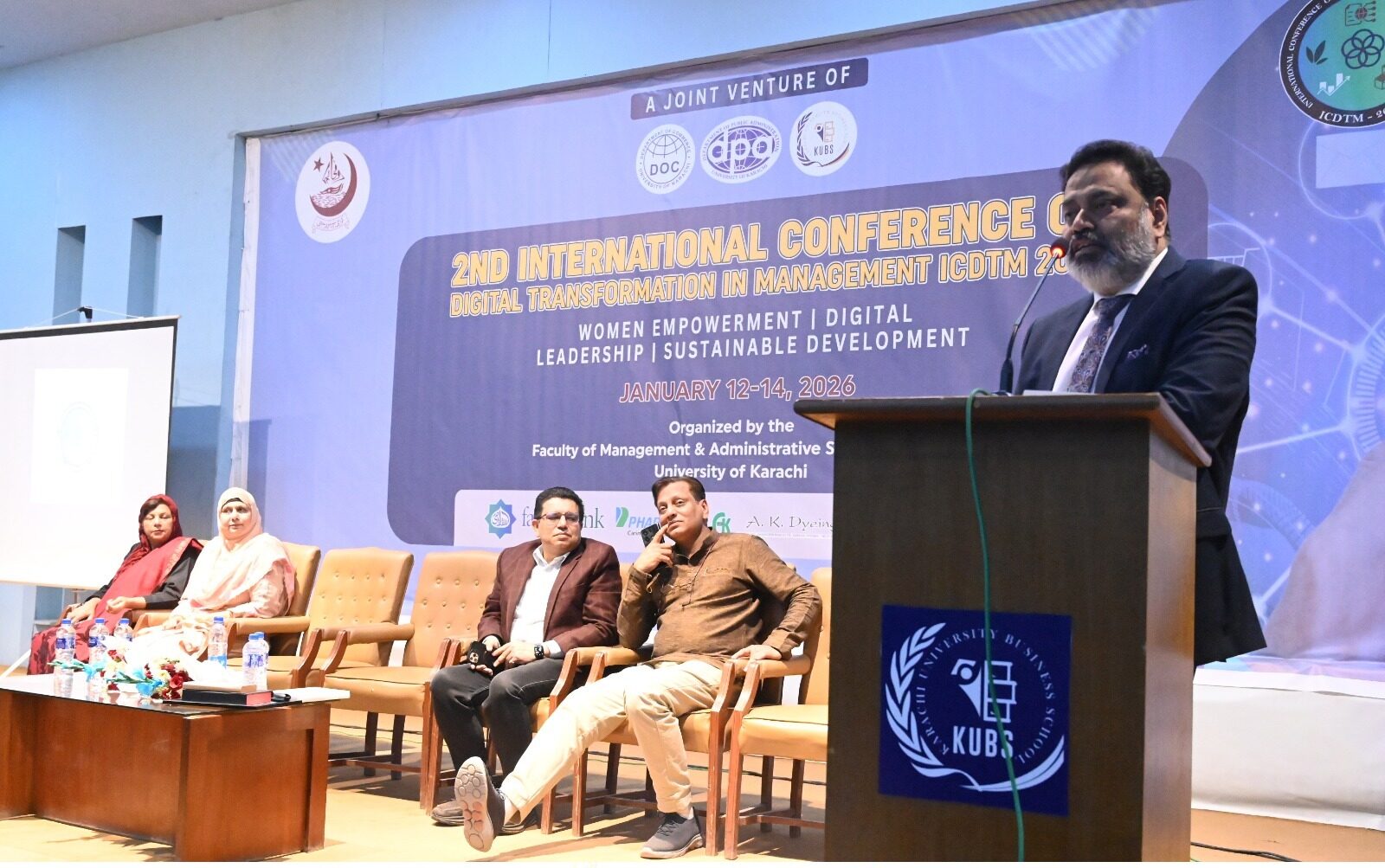
Karachi (HRNW)- The Faculty of Management and Administrative Sciences of the University of Karachi inaugurated its second three-day International Conference at the Karachi University Business School Auditorium, titled “Digital Transformation for Governance, Women Empowerment, Digital Leadership, and Sustainable Development.”
Addressing the inaugural ceremony, the KU’s Vice Chancellor Professor Dr Khalid Mahmood Iraqi mentioned that whether one likes it or not, rapid technological advancement and the flow of information have made change inevitable.
He observed that digital transformation is the only effective path forward in administrative affairs and has become a fundamental requirement of modern management. He stated that digital systems not only enhance institutional performance but also play a pivotal role in guiding organizations toward future prosperity.
The KU VC Professor Dr Khalid Iraqi mentioned that institutions like NADRA and the Election Commission of Pakistan are clear evidence that transparency and trust can be promoted through digital systems. NADRA has demonstrated that digital transformation is not only possible but also indispensable for enhanced governance and efficient administration.
He emphasized that accountability, transparency, and effective delivery mechanisms are the biggest challenges in administration. He shared that NADRA’s adoption of modern technology over the past 10–15 years has significantly enhanced its performance, administrative capacity, and service delivery.
Referring to the Election Commission of India, the KU VC Professor Dr Khalid Iraqi noted that despite limited resources, India has developed a transparent, efficient, and organized electoral system that has strengthened its democratic process. “Human resources are vital, but technology, data, analytics, and modern management practices are key drivers of institutional efficiency.”
The Vice Chancellor of the Federal Urdu University of Arts, Science and Technology Professor Dr Zabta Khan Shinwari shared that empowering a woman digitally means empowering an entire generation sustainably.
He observed that the world does not lack capable and highly educated individuals; what is truly needed is ethics. Many perpetrators of crimes against humanity are not uneducated—they often hold advanced degrees, even PhDs.
He mentioned that the solution lies not only in modern sciences or technology but in nurturing good human beings. We already have excellent doctors, AI experts, and engineers, but we urgently need individuals endowed with natural intelligence, ethics, and compassion.
He added that in today’s age of information abundance, teachers and students must adopt interactive and participatory teaching methods beyond flashy slides—dialogue, Q&A, and active student involvement are essential.
According to Dr Zabta Shinwari, gender gap statistics in the digital economy are crucial. He informed the audience that encouragingly, Pakistan has led South Asia in reducing the mobile internet gender gap—from 38 percent in 2023 to 25 percent now—showing that women are advancing rapidly in the digital economy compared to other countries in the region.
“Our vision must be to build a Pakistan where technology enables every daughter of the nation to lead with dignity. Respect them, trust them, and they will deliver excellence.”
Another speaker, the Dean, School of Mathematics and Computer Science of the Institute of Business Administration, Professor Dr Shakeel Khoja while speaking on digital governance and transformation, revealed that in the past two years, alarmingly, 70,000 IT graduates have migrated abroad, including experienced professionals, posing a serious challenge to the national economy and the future of technology.
He stressed the urgent need to address this trend. On education, he emphasized adopting diverse assessment methods and modern teaching strategies, recognizing that students learn at different paces.
“This shift will transform students from passive learners into active partners in the educational process, laying the foundation for lasting change.”
The Chief Executive Officer at Equinox Industrial Solutions Engineer Sarah Khan highlighted that every project is data-driven, with data collected from on-site conditions and performance. “The real challenge lies in integrating data, maintaining consistency, and converting it into usable digital input.”
Professor Dr Arshian from Malaysian University presented her research paper “Sustainability Beyond Curriculum: Long-Term Thinking in Everyday Business Decisions.” Dr Sana Darvesh, Deputy Manager, Green Social Marketing presented her paper “Women as Agents of Change: Promoting Social Initiatives through Digital Innovation and Sustainable Management.”
Dr Sabine Bhatti, Senior Lecturer, Teesside University, Middlesbrough, UK, presented her paper “Reducing the Digital Gender Divide.” She stressed that digital inclusion from a gender perspective is vital—not just as a good practice but because of its deep social and economic impact, especially in developing countries.
Highlighting AI’s transformative role in education, healthcare, and the economy, she noted its potential to accelerate women’s progress and social inclusion. “Globally, 85% of women and girls face online harassment, a grave challenge requiring strong legal frameworks.”
Earlier, the KU’s Dean FMAS Professor Dr Zaeema Israr Mohiuddin and the Associate Professor at the KU’s Department of Public Administration Dr Mustafa Haider briefed that this year’s conference is aligned with the United Nations Sustainable Development Goal 5 (SDG 5): Women Empowerment.
“The central themes of this year’s conference—women’s empowerment, digital leadership, and sustainable development—are global priorities.”
Meanwhile, special sessions and workshops were also organized under the theme of the event. A parallel session featured around 20 distinguished women leaders from academia and industry, who discussed equality and gender issues in Pakistan.
A side session chaired by Senator Khalid H. Atib focused on women’s empowerment and women as change makers, with women leaders from diverse fields sharing their insights and experiences.
A training workshop titled “Research Baithak” was attended by over 70 delegates. Participants shared research experiences and discussed the Higher Education Commission’s new Weighted General Policy. The workshop also addressed challenges in publishing research journals, identifying predatory journals, and strategies for publishing in impact-factor journals.