











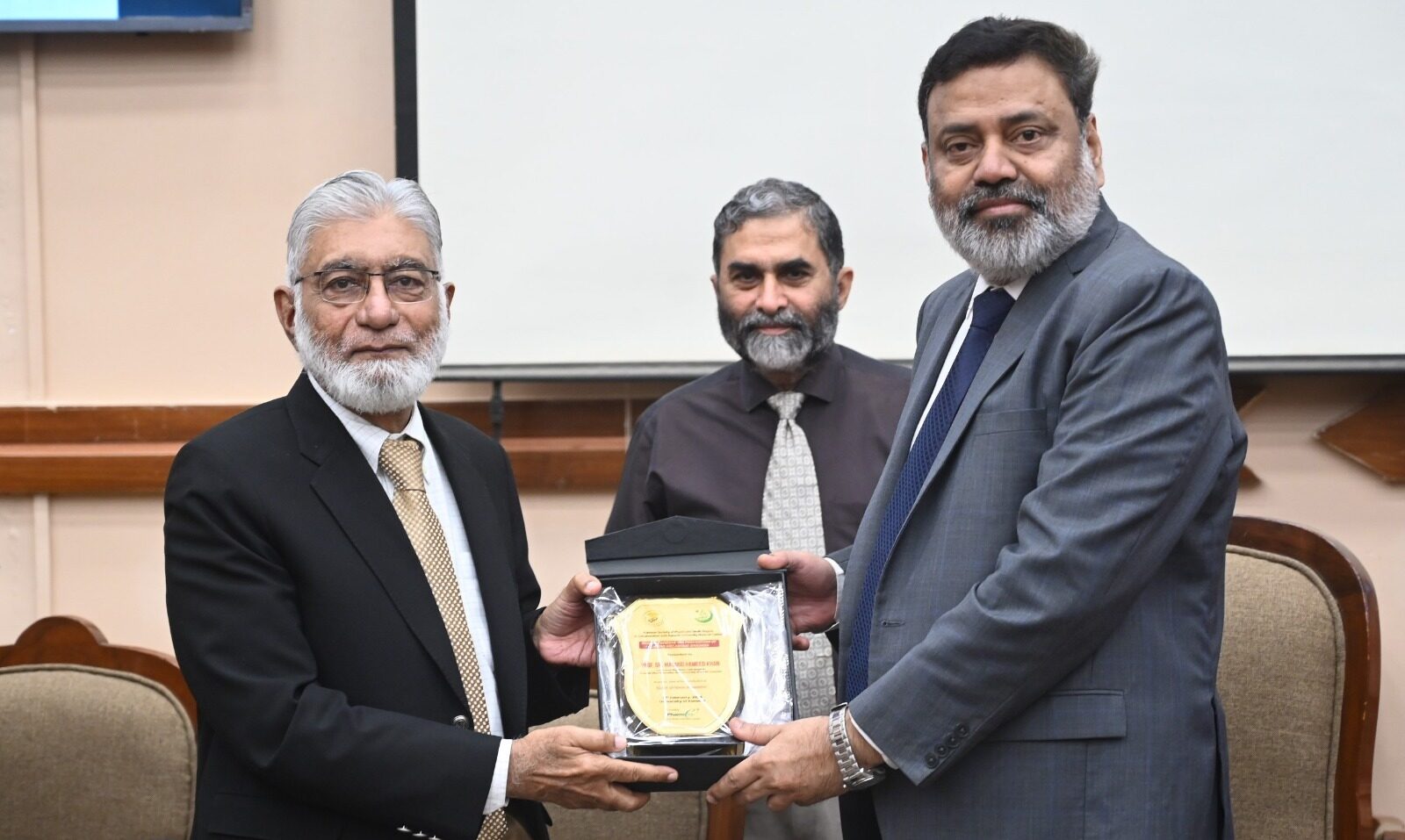
Karachi (HRNW)- The Karachi University Medical Centre and Pakistan Society of Physicians (Sindh Region) organized a seminar entitled protect your healt: understanding the prevention of cardio-metabolic diseases at the KU’s Chinese Teachers’ Memorial Auditorium on Tuesday.
The Founding Vice Chancellor of the Dow University of Health Sciences Professor Dr Masood Hameed Khan explained that carbohydrates provide low quality energy, while proteins and healthy fats serve as high quality fuel. He clarified that not all fats are equal and some benefit health, while others are harmful.
He noted that fruits are a key source of carbohydrates, but fruit juices contain excessive sugar. He mentioned that, for example, a single banana has about 20 grams of sugar, which is equivalent to four teaspoons. He reiterated that reheated oils are extremely hazardous, and this is a fact confirmed by international scientific literature. Instead, he recommended cold pressed oils such as mustard, flaxseed, coconut, and olive oil, acknowledging their higher cost but calling them “the best investment in health.”
Discussing regional data, Professor Dr Masood Hameed said oil consumption in India is similar to Pakistan, while Bangladesh consumes less oil and sugar. He informed the audience that diabetes affects 33 percent of Indians and 20 percent of Bangladeshis, reflecting lifestyle and dietary differences.
The KU VC Professor Dr Khalid Mahmood Iraqi stated that the topic under discussion is of utmost importance as it directly concerns human health. He noted that the third goal of the Sustainable Development Goals focuses on health, improved quality of life, and overall well being. He expressed satisfaction that Pakistan’s average life expectancy has risen from 62 to 64 years, but warned that the decline in overall quality of life is alarming.
He explained that various physical and mental illnesses not only cause stress and family problems but also leading to severe financial difficulties. The KU VC Professor Dr Khalid Iraqi emphasized that rather than waiting for diseases to intensify, early diagnosis, the adoption of healthy diets, and the promotion of active lifestyles are urgent needs of the time.
Another speaker, Co-ordinator Pakistan Society of Physicians (Karachi Chapter) Dr Syed Riaz ul Hassan shared that obesity is not merely a matter of willpower but a complex and chronic disease linked to more than 200 conditions.
He described obesity as a “gateway disease,” laying the foundation for diabetes, heart disease, and liver disorders. According to the World Obesity Federation, obesity among children and adolescents is rising at an alarming rate.
The KU’s Medical Consultant Dr Akmal Waheed stated that cigarette smoke contains more than 4,000 chemical compounds, at least 200 of which are toxic. He added that cardiovascular diseases are the leading cause of death worldwide, claiming nearly nine million lives every year.
On this occasion, the Consultant Physician and Vice President of the Pakistan Society of Physicians (Sindh Region) Professor Dr Qaiser Jamal stated that the prevalence of obesity in Pakistan has reached 58 percent, while issues of stress and depression have climbed to 88 percent which is a deeply alarming situation. He emphasized that without changes in mindset and lifestyle, it is impossible to control these diseases.
During the event, health experts also discussed Metabolic Dysfunction Associated Steatotic Liver Disease (MASLD), formerly known as non alcoholic fatty liver disease. They mentioned that it affects over 30 percent of the global population and has become a major public health challenge in Pakistan.
They added that among adults with type 2 diabetes, 75 percent suffer from MASLD, while prevalence in the general population is around 47 percent. They observed that awareness among 20–40 year olds remains critically low, despite being the most affected group. A U.S. study found that over 95 percent of patients were unaware of their condition.
The seminar concluded with a panel discussion featuring former President of the Pakistan Cardiac Society Professor Dr Khalida H. Soomro, Professor Dr Shahbaz Haider, and Professor Dr Atiya Sabin Rahman. They answered participants’ questions and engaged in detailed discussions on prevention strategies, which were highly appreciated by the audience.