








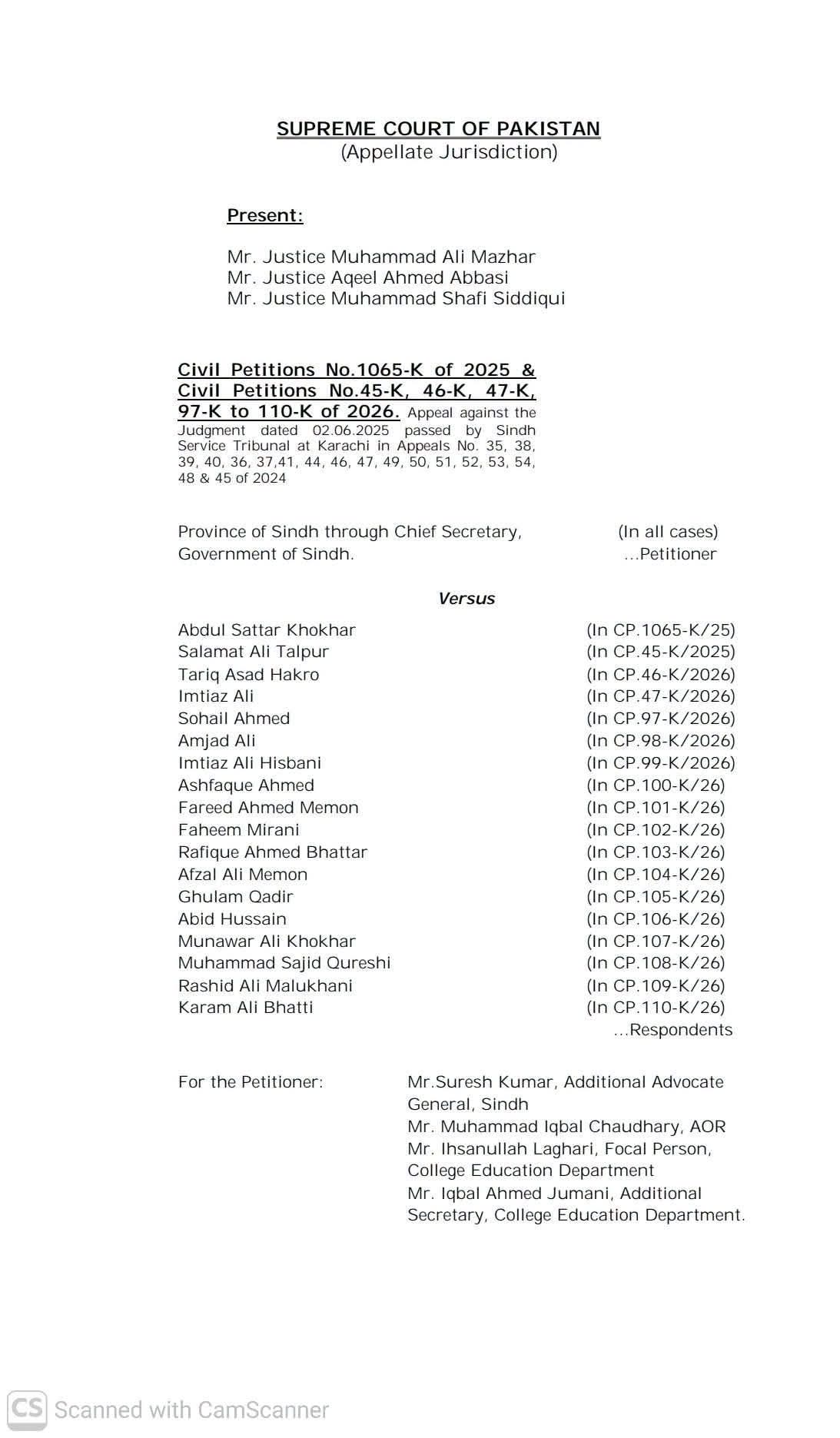
Islamabad (HRNW)- The Supreme Court of Pakistan, in Civil Petitions No. 1065-K of 2025 and others, has issued an important judgment upholding the decision of the Sindh Services Tribunal regarding the determination of seniority among government employees.
The case pertained to the inter-se seniority of lecturers in the College Education Department of Sindh, where appointments were made through the Sindh Public Service Commission (SPSC) in different phases and at different times for various subjects. A consolidated seniority list was later prepared, which was challenged by some officers on the grounds that although they were selected earlier, they were placed at par with or below those selected later.
The Sindh Services Tribunal had accepted the appeals and held that under Rule 11(a) of the Sindh Civil Servants (Probation, Confirmation & Seniority) Rules, 1975, an employee selected in an earlier selection process must rank senior to those selected in later selections.
The Government of Sindh challenged this decision before the Supreme Court.
After detailed consideration, the Supreme Court observed that the wording of Rule 11(a) is clear and unambiguous, stating that a person selected in an earlier selection shall rank senior to a person selected in a later selection. The Court held that the date and batch of selection cannot be ignored while determining seniority.
The Court further observed that if a tribunal’s decision affects the seniority of an employee, the aggrieved employee has the right to challenge it, and the government cannot file an appeal merely on the basis of dissatisfaction with the outcome. It emphasized that the government must act as a fair employer rather than as an adversarial party in disputes between employees.
Finding no legal error, irregularity, or jurisdictional defect in the Tribunal’s judgment, the Supreme Court dismissed all civil petitions.
The ruling is considered a significant precedent in service law, particularly regarding seniority, promotion, and inter-se seniority disputes, reaffirming that employees selected earlier will hold seniority over those selected later.
Disclaimer:
This report is based on the described Supreme Court judgment and related legal proceedings. It does not constitute legal advice.