








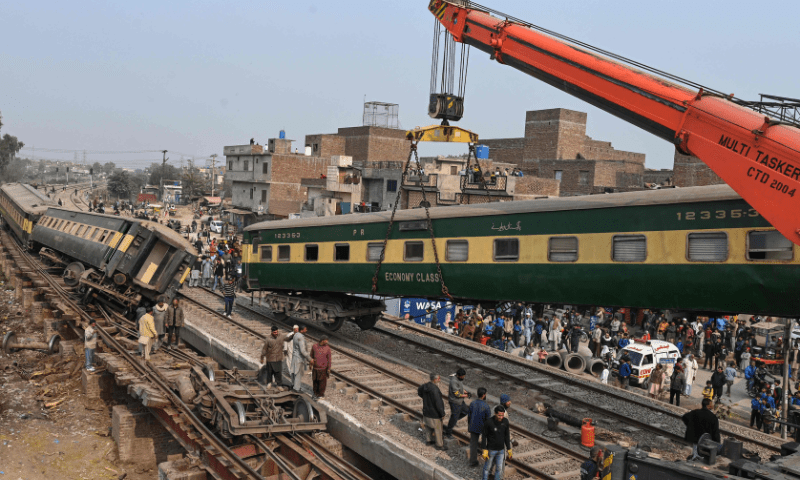
Lahore (HRNW)- Pakistan Railways is facing mounting operational challenges as its aging infrastructure has led to a series of train accidents, severe delays, and the temporary suspension of services on several routes, raising concerns over passenger safety and freight transportation.
According to reports, four to five railway accidents during the past two months have raised alarm over the condition of the country’s rail network. Recent floods have further damaged infrastructure, forcing the temporary suspension of rail services to Faisalabad and trains operating between Karachi and Faisalabad, leaving thousands of passengers stranded and causing daily financial losses worth millions of rupees for Pakistan Railways.
The railway network, much of which dates back more than 125 years, has become severely worn out. Passenger and freight trains are now operating at significantly reduced speeds due to deteriorating tracks, while attempts to increase speed have reportedly resulted in derailments and other accidents.
According to information obtained by HRNW News, nearly 1,100 kilometers of Pakistan Railways’ approximately 2,000-kilometer track network is operating under engineering restrictions. Train drivers have been instructed not to exceed reduced speed limits because of safety concerns.
Although the official speed limit for passenger trains is 110 kilometers per hour, trains often travel between 55 and 78 kilometers per hour, while some sections of track, particularly between Sukkur and Karachi, limit speeds to 30–50 kilometers per hour due to more than 100 engineering restrictions.
Railway officials say that infrastructure upgrades have remained stalled since 2015 because of delays in the ML-1 project under the China-Pakistan Economic Corridor (CPEC). As a result, despite having locomotives and coaches available, Pakistan Railways has struggled to maintain punctual train operations.
Flooding has also damaged a railway bridge near Qila Sattar Shah, resulting in the suspension of train services, including the Shalimar Express operating between Karachi and Faisalabad. Passengers traveling on the affected routes are currently relying on road transport until repair work can begin after floodwaters recede.
Meanwhile, Federal Minister for Railways Hanif Abbasi said Pakistan Railways earned a record Rs115 billion in revenue despite operational challenges. He stated that agreements worth billions of rupees have been finalized with domestic and international financial institutions, while infrastructure development projects, including the Karachi–Sukkur division, will begin this year.
The minister added that the upgradation of railway stations in Lahore, Karachi, Faisalabad, and Rawalpindi is underway and that efforts are continuing to improve passenger facilities, modernize railway services, and expand public-private partnerships in train operations.
Support independent journalism and human rights reporting by making a donation: http://www.hrnww.com/?page_id=1083