






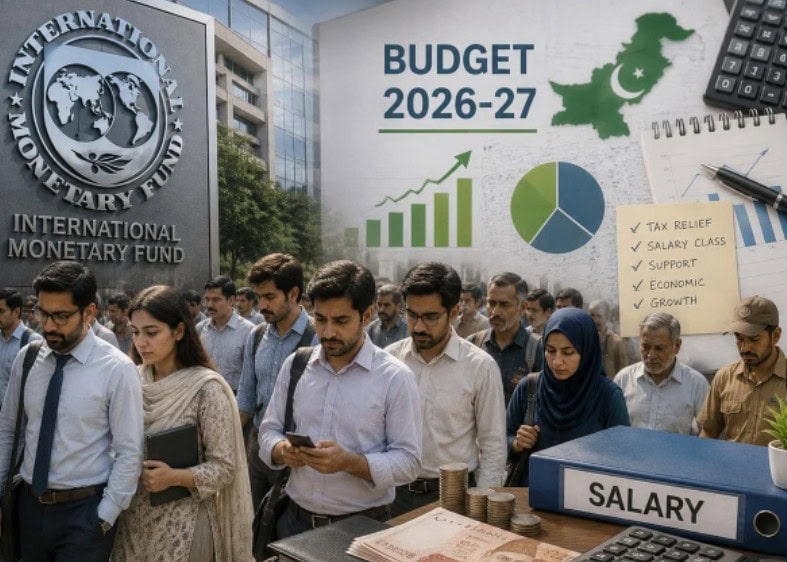
Islamabad (HRNW)- As the federal government prepares to unveil the Budget 2026-27, questions are once again being raised about who bears the largest tax burden in Pakistan and why several influential sectors remain outside the effective tax net.
Millions of salaried employees across the country pay income tax directly through deductions from their monthly salaries. Despite this, they continue to pay various indirect taxes on everyday necessities, including fuel, mobile phone services, electricity, and consumer goods.
A teacher at a private educational institution in Islamabad said that even after income tax is deducted from her salary, she is required to pay additional taxes on petrol, mobile services, and other essential items, placing further pressure on her household budget.
Similarly, individuals involved in online businesses have expressed concerns that petroleum levies and other indirect taxes are increasing their financial burden.
With the new fiscal year beginning on July 1, the government is finalizing the federal budget amid IMF program commitments and fiscal deficit reduction targets. This has sparked concerns among taxpayers that additional revenue measures may once again disproportionately affect sectors already contributing heavily to the national exchequer.
According to official figures, a substantial portion of Pakistan’s tax revenue is generated through indirect taxation, resulting in low-income and high-income consumers often paying similar tax rates on many products and services.
Economists argue that this structure places a heavier burden on ordinary citizens and lower-income households.
Financial data shows that the government collected more than Rs1,200 billion in petroleum levy during the current fiscal year, a figure that has increased significantly over recent years due to higher levy rates.
Experts note that such taxes directly impact transportation costs, prices of essential goods, and overall inflation.
According to Federal Board of Revenue (FBR) data, the salaried class contributed more than Rs605 billion in income tax during the last fiscal year. Analysts say that this sector’s contribution continues to exceed that of several major business and real estate sectors.
The agriculture sector remains a central topic in tax reform discussions. Although it represents a major component of Pakistan’s economy, experts believe its contribution to tax revenues remains comparatively low.
Economists stress that sustainable tax reform requires bringing large landowners and other influential groups into the tax net to ensure a fairer distribution of the tax burden.
Likewise, a significant portion of wholesale and retail trade remains undocumented. Despite repeated government efforts to document the sector and increase compliance, desired outcomes have yet to be fully achieved.
Experts also point out that many individuals possess substantial financial assets that are not reflected in tax records. They suggest that digitalization, improved monitoring systems, and a simplified tax structure could substantially increase revenue collection without imposing additional taxes on existing taxpayers.
Business and industrial circles have also voiced concerns regarding high tax rates, rising energy costs, and increasing operational expenses. They argue that economic growth and investment require broadening the tax base rather than repeatedly taxing documented sectors.
As the budget announcement approaches, citizens, salaried employees, and business leaders are calling on the government to prioritize tax reforms, expand the tax net, and bring long-undocumented sectors into the formal economy instead of placing further financial pressure on those already paying taxes.
Your support helps us continue delivering accurate and timely news coverage.
Donate here: HRNW Donation Page